With the new year upon us, it causes one to think of the wishes, hopes, and resolutions for the year ahead. Some wish to lose weight. Some resolve to eat better. Some hope for a change in their circumstances - a new job, a new house, a new {insert want or need}. At the heart of these explorations is a search into identity - who we think we are or should be or want to be seen as.
In November 2010, historian Simon Schama published in The Guardian his vision of how and why history should be taught in schools. In this article, he states that history is not a measure to merely calm or please arguments and misfortunes. "It's exactly because history is, by definition, a bone of contention that the arguments it generates resist national self-congratulation."
The Greek word historia meant and was used as "inquiry." The "father of history" Herodotus traveled and wrote about the people and places he saw examining the cultures and legends of regions he ventured through. So, according to Schama, the inquiry into a nation's history "is not the uncritical genealogy of the Wonderfulness of Us, but it is, indispensably, an understanding of the identity of us." The investigation and analysis of history is integral to the self-examination of who we are today.
I am preoccupied with this inquiry into the past to better understand today. Who are we and why? What is the impact of this political incident or that economic event on the culture and society of a peoples? How did it all coalesce into a nation and a national identity?
As an anglophile, I've chosen to delve in to British history to explore these questions. I hope to consider these weighty inquiries in this forum throughout the coming year. Answers may not be found and further questions may result, but the conversation will begin.
Wednesday, January 12, 2011


Thursday, December 23, 2010
The House of Gingerbread
With the holiday season comes the practice for some of creating a gingerbread house, an architectural feat that can be as amazing to view as it would be to eat the goodies that are used as construction materials.
Germany has a long and strong tradition of creating flat and shaped gingerbreads. The strong and flat gingerbread, Lebkuchen, are used to make gingerbread houses - also called Hexenhaeusle, which means "witches' houses," from the fairy tale Hansel and Gretel, or Lebkuchenhaeusel and Knusperhaeuschen, which means "houses for nibbling at".
Nuremberg, the "gingerbread capital" of the world, hosted Christkindlmarkt in December, a fair where Christmas decorations and seasonal foods were purchased. Gingerbread was not baked in homes but by a special guild of master bakers known as the Lebkuchler. Gingerbread bakers collaborated with sculptors, painters, and woodcarvers to create intricately designed and beautifully decorated gingerbread cakes. With these partnerships, it is easy to imagine how gingerbread houses were soon created.
During the nineteenth century, gingerbread was both modernised and romanticised. The practice of making gingerbread houses was brought by German immigrants to America where the practice grew and resulted in extraordinary creations. Elaborate Victorian houses and tiny one-room cottages were heavily decorated with candies and sugary creations and thus the tradition took off.
For inspiration in designing your own gingerbread house, here is more information on the Sugar Castle pictured above by chef Jean-Francois Houdre.
Source: Gingerbread House
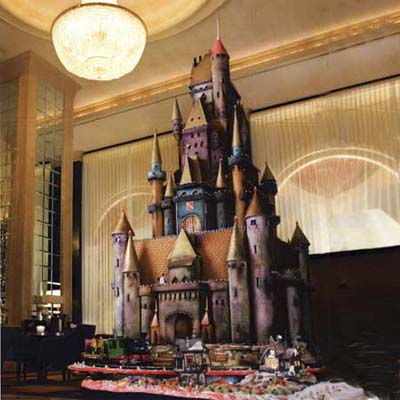 |
| The Sugar Castle, a gingerbread house, at the Westin St. Francis hotel in San Francisco |
Germany has a long and strong tradition of creating flat and shaped gingerbreads. The strong and flat gingerbread, Lebkuchen, are used to make gingerbread houses - also called Hexenhaeusle, which means "witches' houses," from the fairy tale Hansel and Gretel, or Lebkuchenhaeusel and Knusperhaeuschen, which means "houses for nibbling at".
Nuremberg, the "gingerbread capital" of the world, hosted Christkindlmarkt in December, a fair where Christmas decorations and seasonal foods were purchased. Gingerbread was not baked in homes but by a special guild of master bakers known as the Lebkuchler. Gingerbread bakers collaborated with sculptors, painters, and woodcarvers to create intricately designed and beautifully decorated gingerbread cakes. With these partnerships, it is easy to imagine how gingerbread houses were soon created.
During the nineteenth century, gingerbread was both modernised and romanticised. The practice of making gingerbread houses was brought by German immigrants to America where the practice grew and resulted in extraordinary creations. Elaborate Victorian houses and tiny one-room cottages were heavily decorated with candies and sugary creations and thus the tradition took off.
For inspiration in designing your own gingerbread house, here is more information on the Sugar Castle pictured above by chef Jean-Francois Houdre.
Source: Gingerbread House
Monday, November 15, 2010
Victoria's Namesake
To continue with the Victorian theme that TAJ has taken lately...
I recently traveled to Victoria, British Columbia and was amazed by how devoted this city was to Queen Victoria and nineteenth-century Britain. In many ways, I felt more like I was visiting Great Britain than British Columbia. Though in a Commonwealth country and almost on the other side of the world from Britain, I was struck by how this city has retained a British sensibility.
I recently traveled to Victoria, British Columbia and was amazed by how devoted this city was to Queen Victoria and nineteenth-century Britain. In many ways, I felt more like I was visiting Great Britain than British Columbia. Though in a Commonwealth country and almost on the other side of the world from Britain, I was struck by how this city has retained a British sensibility.
Founded in 1843, during Queen Victoria's reign, Victoria became the capital of British Columbia, Canada in 1866 when Vancouver Island united with the mainland. A statue of Queen Victoria stands in front of the Provincial Legislature Building, called "Parliament."
 |
| Statue of Queen Victoria in front of Parliament at night. (RS) |
Scottish and English colonists ventured far from their homeland, bringing with them not just their hopes and dreams for a new life in a new world, but also their British customs and a domesticating Old World awareness to this new corner of the Empire.
When Vancouver across the Salish Sea began to draw business away from Victoria in the 1920s, British patriotism and customs could have followed, which would have resulted a very different Victoria than what I saw. Instead, an American by the name of George Warren, in the Victoria Publicity Bureau, devised a marketing campaign to publicize Victoria using the theme of "Olde England" to sell Victoria as more akin to the Old World.
While Vancouver leveled its downtown to make room for a modern city-scape, Victoria preserved its heritage buildings and added gardens and city parks. This urban plan to nurture the city as it was enabled a lively, walkable historic city center to be maintained.
Though modern buildings were to be erected:
 |
| View of Victoria (RS) |
 |
| The Empress Hotel and harbor at night (RS) |
Just as enjoyable as walking the city and viewing its beauty is another British custom that has been preserved - High-Tea. Considered a delicacy, it is offered in many locations for the weary tourist to indulge in. And indulge I did.


Sources:
Wikipedia: Victoria, British Columbia - http://bit.ly/1cytDg
Subscribe to:
Posts (Atom)